
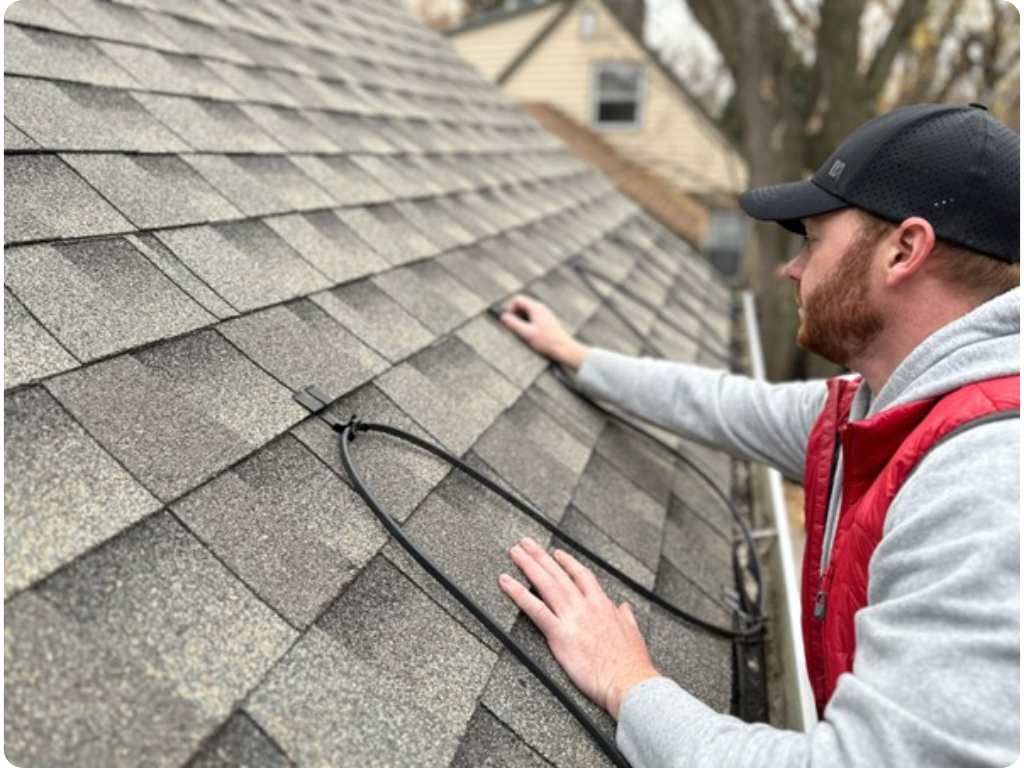
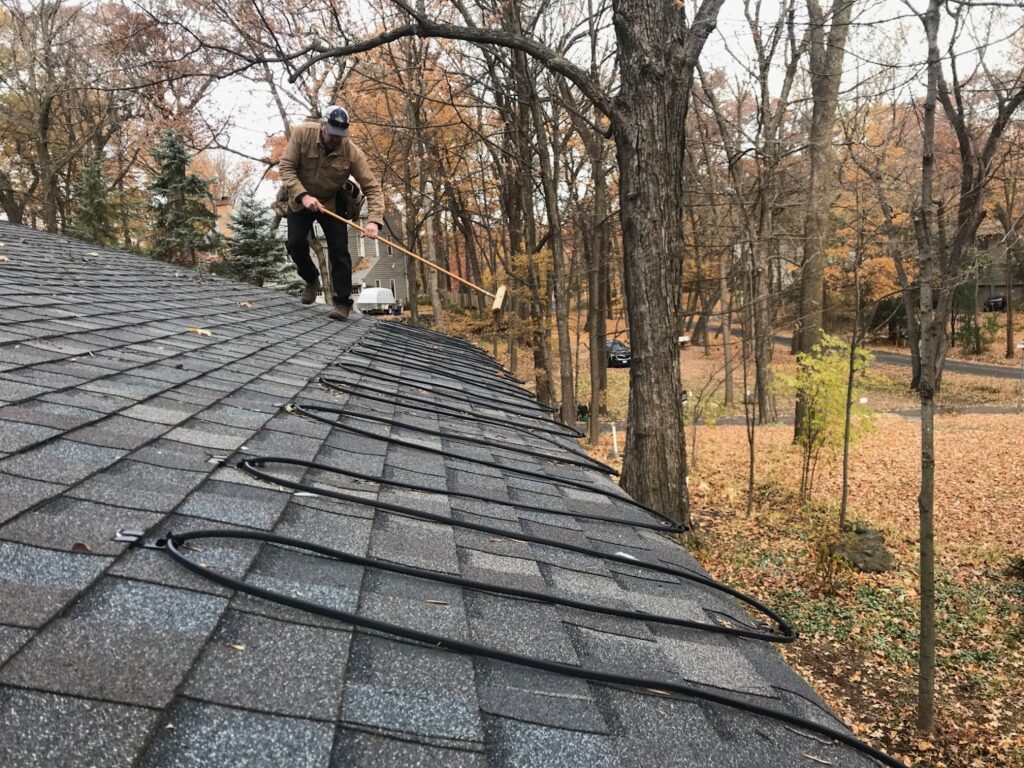
Underestimating the gravity of a failed heat cable system can be pretty catastrophic. We’ve discovered there are many contractors around the country who call themselves heat tape ‘experts’ despite the fact that they know very little about the topic. The wrong cable, improper installation methods, or cut-rate materials can lead to ice dam damage, voided roof warranties and costly replacements within the first year.
If you are hiring someone to install heat cable on your home, here are some good questions you should ask to ensure the best outcome possible.
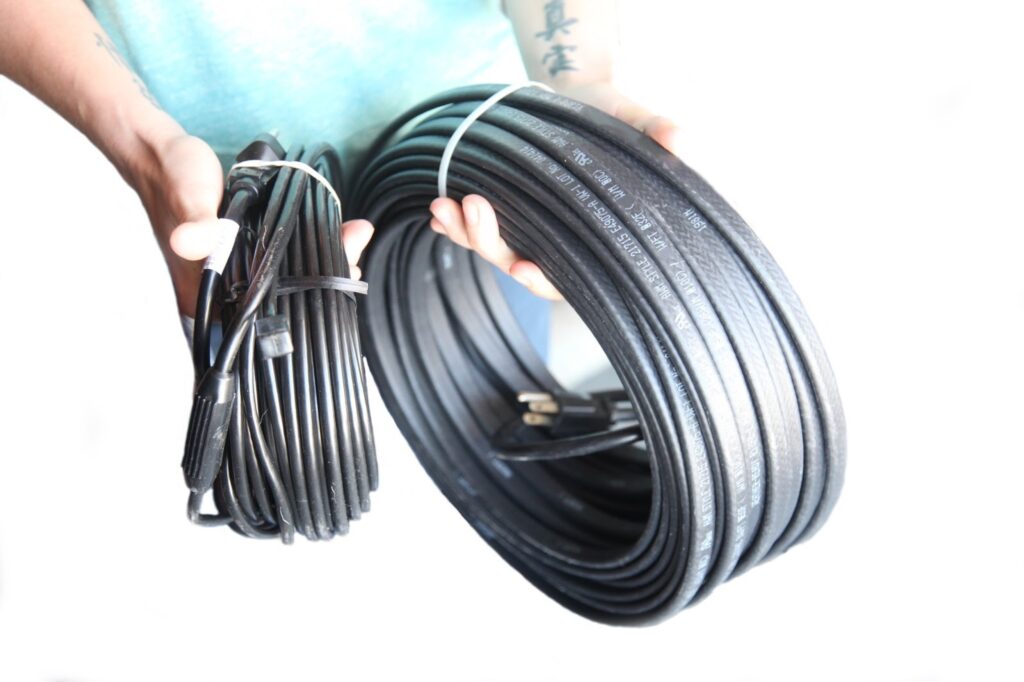
First things first, you should avoid constant wattage brands including EasyHeat, FrostKing, Wrap-On or any cheap product available from a big box store. Only self-regulating heat cable should be used (made by Radiant Solutions or another reputable manufacturer).
Why Self-Regulating Heat Cable Is Essential
Self-regulating cables automatically adjust heat output based on surrounding temperature. They draw more power when temperatures are cold and less when temperatures are warmer. This makes them more energy-efficient than constant wattage heat cable.
In contrast, constant-wattage heat tape stays “hot, hot, hot, 100% of the time when plugged in“. Cheap constant-output cables are inefficient, short-lived and even pose fire hazards if misused.
Ask for Technical Documentation
Always ask for the technical documents relating to the heat cable being proposed. For more information on why constant wattage cable is a bad choice, see Case Study #133.
The manufacturer’s technical data or installation manual will confirm the cable type and its ratings. This documentation helps you verify that the cable is self-regulating and rated for roof deicing use. Technical specs also show the cable’s wattage output per foot, operating temperature range, and approvals.
A reputable installer should willingly provide these documents. If they hesitate or only offer a generic “heat tape” without details, consider that a red flag.
Warranty length is one of the simplest ways to gauge the quality of a heat tape system. In general, longer warranties reflect better materials, more durable construction, and a product that is expected to perform for many seasons.
Always ask what warranty the manufacturer provides on the cable itself and request that information in writing. Heat tape warranties vary widely across the market. Many lower cost or constant wattage cables are covered for only one or two years. Short warranties often signal a shorter expected lifespan and less tolerance for harsh conditions.
Self regulating heat cables typically carry longer warranties because they are designed to handle temperature swings more effectively and reduce stress on the cable over time. Depending on the manufacturer, coverage may range from five to ten years. For example, some premium systems, including Heat Tape PRO, offer a ten year warranty which is among the longest currently available in this category.
If a contractor proposes a product with only a year or two of coverage, it is worth asking why. In many cases, this points to a constant wattage or entry level cable rather than a higher grade system intended for long term use.
Product warranty is only part of the picture. It is equally important to understand how the installer stands behind their work. A professional contractor should offer a workmanship warranty that covers installation related issues such as improper connections, routing errors, or mounting problems.
Many reputable installers provide one to two years of labor coverage and will also assist with manufacturer warranty claims if the cable itself proves defective. This type of support can save time and expense if an issue arises.
Be cautious if an installer offers no labor warranty or relies solely on the manufacturer’s coverage. That approach may leave you responsible for service calls or repairs even when the issue stems from installation. All warranty terms, both for the product and the labor, should be clearly documented in the contract before work begins.
A strong warranty does not guarantee that problems will never occur, but it does show that both the manufacturer and the installer expect the system to last and are prepared to stand behind it.
In most cases, heat tape is safe when it is installed exactly according to the manufacturer’s instructions. The challenge is that real world conditions are rarely perfect. When installation guidelines are not followed precisely, certain types of heat cable are far less forgiving than others.
Constant wattage heat cable is the clearest example. These systems produce the same amount of heat at all times and rely heavily on strict installation rules to remain safe. They are typically not intended to touch combustible materials such as wood, leaves, or pine needles. They must also never overlap or cross over themselves. If those conditions are violated, the cable can overheat, fail prematurely, or create a fire risk. Many lower cost heat tapes include explicit warnings about prolonged contact with debris for this reason.
In practice, it is difficult to guarantee ideal conditions year after year. Leaves collect in gutters. Pine needles fall onto roof edges. Snow and ice can shift cables out of position. Even a careful installation can change over time as winter takes its toll.
Self regulating heat tape behaves differently. These systems automatically reduce heat output when temperatures rise or when heat builds up in one area. Because of this, they are approved for use on all common roof materials and can safely come into contact with naturally occurring debris around the home. They also do not overheat when overlapped which is an important safety advantage in real world installations where cables can move or settle.
This ability to tolerate overlap and contact makes self regulating cable a safer and more reliable choice for most residential roof and gutter applications, especially in environments where perfect conditions cannot be maintained.
Choosing the right installer matters just as much as choosing the right heat tape. While installing heat cable does not require complex construction skills, it does require experience, attention to detail, and an understanding of how ice forms and how water moves.
Start by asking what the contractor does most often. Is heat tape installation a regular part of their work or an occasional add on? How many systems have they installed and over what period of time? Contractors who specialize in heat cable or ice dam prevention usually make that clear on their website. Look for dedicated service pages, photos of completed projects, and explanations of their installation approach.
When speaking with installers, ask direct questions. How many heat tape systems have you installed? Is this a core service for your company? Clear answers are a good sign that the contractor understands the work and stands behind it.
Experienced installers have worked on a wide range of roof materials and configurations. Asphalt shingles, metal roofs, flat roofs, cedar, and complex rooflines each present different challenges. A seasoned professional should be able to describe how their approach changes depending on the roof type.
It is also important to confirm that the contractor is properly licensed and insured. Heat tape work involves both roofing and electrical components. Insurance coverage and licensing protect you if something goes wrong and signal that the contractor operates as a legitimate business.
Reputable installers are usually willing to share examples of past work. This might include before and after photos, project summaries, or references from customers whose systems have been in place for several winters. Long term references are especially valuable because they show how the system performed over time.
Heat tape installation is not complicated, but it is specialized. Pricing that is far lower than other estimates can be a warning sign. Very low bids may reflect cheaper materials, limited experience, or an incomplete understanding of the scope of work.
In many cases, problems traced back to poor installation end up costing more in the long run through repairs, cable replacement, or roof damage. Paying a bit more for an experienced installer who does this work regularly often leads to better results and fewer headaches later.
Understand the Contractor’s Support and Response
A properly designed and installed heat tape system should require very little ongoing attention. High quality self regulating cable is built to run quietly in the background for years. That said, winter is hard on everything. Heavy snow, shifting ice, loose clips or animal damage can interrupt even the best system.
The most important factor in resolving a problem quickly is having the right support. If a heat tape system stops working, you want to know exactly who to call and what to expect. A contractor who regularly installs heat cable should be able to diagnose issues quickly and fix most problems without major expense.
Before installation, it is worth asking a few direct questions. How are service calls handled? What is the typical response time during winter? Is there a charge if the issue is not covered under the manufacturer warranty? Clear answers now can prevent frustration later.
Reliable installers usually have a straightforward service plan. Some offer direct phone support. Others provide priority scheduling for warranty work or seasonal inspections. Many experienced contractors also recommend occasional checkups, especially before or during the coldest part of the winter.
The goal is simple. Choose an installer who plans to be around after the job is done. Companies that specialize in heat cable systems tend to value long term relationships and take pride in being available when customers need help. That experience often makes the difference between a minor repair and a prolonged winter headache.
Whether a heat tape system can be repaired depends entirely on the type of cable that was installed. This is an important detail that many homeowners do not consider until something goes wrong.
Constant wattage heat tapes are not designed to be repaired. If the cable is cut, nicked, frayed, or shorted, the entire run typically has to be replaced. Manufacturers of these products generally do not offer approved repair or splice kits, which means even minor damage can render the cable unusable or unsafe.
In real world conditions, damage is not uncommon. Animals can chew on exposed sections. Ladders or tools can accidentally nick the cable during maintenance. When that happens with a constant wattage system, replacement is the only option. This adds both material cost and labor expense and can turn a small issue into a larger repair project.
Because of this limitation, constant wattage systems are often treated as disposable. They work until they do not, and when they fail, the solution is a full replacement rather than a repair.
Self regulating heat cable is built differently and is intended to be serviceable. Most reputable manufacturers offer approved repair kits that allow damaged sections to be cut out and replaced. These kits typically include splice components and end seals and are relatively inexpensive.
If a section of self regulating cable is damaged, a technician can usually remove the affected portion and restore the system without replacing the entire run. This makes repairs faster, more affordable, and less disruptive. It also allows systems to be modified or extended if changes are needed in the future.
Because of this repairability, self regulating systems are often viewed as long term installations rather than single use products. When discussing options with an installer, it is worth asking a simple question. If the cable is damaged, can it be repaired or does the entire system need to be replaced?
The answer provides useful insight into both the type of cable being proposed and the long term ownership costs of the system.
A properly installed heat tape system should not damage your roof or affect the roof manufacturer’s warranty. Problems usually arise when the attachment method is wrong.
Most professional heat tape installations on asphalt shingle roofs should not require drilling, nailing, or screwing into the roof surface. Such methods may be required for certain metal roof systems.
Experienced installers use non penetrating clips or adhesive mounted brackets that hold the cable in place without creating holes. These systems secure the cable while preserving the integrity of the roofing materials. For example, Grip Clips hold onto shingles in a way that eliminates the need for fasteners. This matters because most roofing manufacturers clearly state that unapproved penetrations can void their material warranty and increase the risk of leaks.
Any fastener that goes through shingles, underlayment, or roofing panels introduces a potential failure point. Over time, those penetrations can lead to water intrusion, especially in freeze thaw conditions. Using non-invasive attachment methods avoids that risk altogether.
Not all installers use the same accessories or techniques. Some still rely on nail down clips or screw mounted brackets even though better options exist. That is why it is important to understand exactly how the system will be installed.
Ask your contractor how the cable will be fastened and what parts will be used. Their proposal should clearly list the cable type and manufacturer, warranty, attachment method and any controls or accessories. Transparency here allows you to confirm that the installation approach aligns with roof manufacturer guidelines.
A qualified installer should be able to explain their plan clearly and confidently. For example, they may describe using adhesive mounted clips on metal roofing or clamp style attachments on asphalt shingles that require no nails. Having this documented in writing protects you and ensures the installer follows through on the agreed method.
Heat tape itself does not damage roofs. Improper installation does. By confirming the use of manufacturer approved, non penetrating attachment systems, you protect your roof, maintain warranty coverage, and ensure the heat tape system performs as intended for years to come.
The cost of professional heat tape installation varies based on the home and the type of system being installed. What matters most is not just the number at the bottom of the estimate but how clearly that number is explained.
A reputable heat tape installer will provide a highly detailed proposal breaking down all costs. The proposal should list materials (length of cable, type of cable, number of clips, controllers or thermostats, downspout extensions, etc.) and labor (installation timeframe, any special electrical work, etc.) separately.
This level of detail not only justifies the cost but also shows exactly what you’re paying for. As one expert heat tape installer in Minneapolis notes, their proposals are extremely detailed so customers “understand what they are buying.”
If a proposal is vague, ask for clarification. You want to avoid hidden costs or inferior materials. Transparency in the bid is a hallmark of a professional installation.
Understanding the Investment
Professional heat cable installation is not cheap upfront, but it provides significant long-term value. The cost can vary widely based on your roof and needs.
| Cost Factor | Impact on Price |
| Cable Length | More cable = higher cost |
| Cable Type | Premium self-regulating costs more per foot than hardware-store cable |
| Roof Complexity | Multiple stories, steep pitches, or special roofing increase labor and accessory costs |
| Power Supply Setup | Installing new outlets or circuits adds cost |
| Climate Severity | Colder regions might need more cable or higher wattage |
| Control Systems | Heat cable system controls can add significant cost to a project |
Generally, many professional installers report that typical residential heat tape systems cost between $1500 and $2,500. On a per-foot basis, installed self-regulating cable tends to cost roughly $10–$20 per foot, depending on the complexity and accessories.
Long-Term Value and Savings
While professional installation is a larger upfront investment, it often costs less over time. Lower cost systems frequently rely on basic cable and minimal coverage which can leave ice dams unresolved or lead to early failure. Replacing a failed system after one or two winters quickly erases any initial savings.
Experienced installers often report that a large portion of replacement work involves removing short lived constant wattage cable that failed prematurely. In contrast, well designed self regulating systems commonly last a decade or more.
Energy use is another factor. Self regulating cable reduces power output as temperatures rise which lowers operating costs during milder winter conditions. Constant wattage systems draw full power whenever they are on which can lead to higher electric bills over time.
When evaluating cost, it helps to think beyond the installation price. A properly designed system can prevent roof leaks, avoid repeated replacements, and reduce energy use. In that context, professional installation is less about paying more and more about paying once for a system that works.
If you are looking for a reputable contractor to install a Radiant Solutions Company heat cable system, we can help. Finding the right person is surprisingly easy. Click here to see if we know someone in your neighborhood. We’ll do our best to find someone to help.
Regardless of who you choose, you should ask the above questions. Vetting contractors who install heat tape systems on residential and commercial roofs and gutters is no different than other fields of contracting. Proposals should be detailed with information on a bill of all supplies and materials being used.
Additional Resources
