

Almost all of the calls we receive about failed heat cables relate to either: 1) Issues involving the power supply or, 2) Damaged cable. Manufacturing defects in Heat Tape PRO self-regulating cable are exceedingly rare. Let’s walk through the common problems with self-regulating heat tape and their solutions so you can quickly diagnose and fix what’s going on.
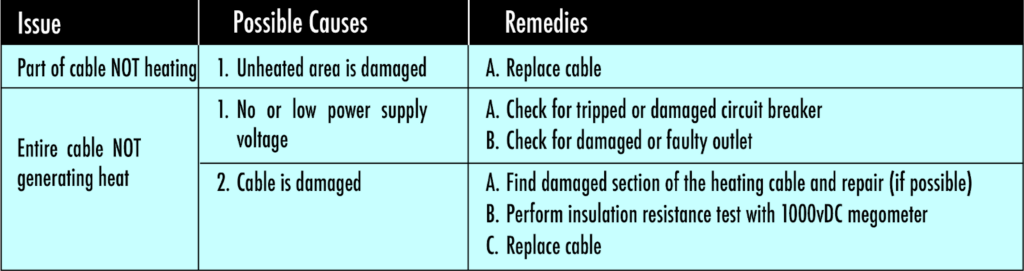
If one section of the heat tape is warm but another section is not, it almost always means the cable is physically damaged at the point where it goes cold. In a self-regulating heat tape like Heat Tape PRO, an internal break or water intrusion will prevent that segment from heating, even while the rest of the cable before the break might still get warm. Common causes are a cut or nick in the jacket, a crushed/kinked section, or any breach that lets water into the cable, which effectively “kills” the heating circuit beyond that point. Once water gets into that part of the cable, you can’t restore heating to that segment.
If water has gotten into the cable, replace the entire cable. We strongly suggest not attempting to patch a water-damaged cable, because the repair won’t hold. If the damage is fresh and dry, a splice repair may work. See Can I Repair a Damaged Section of Heat Tape? below.
If your heat tape isn’t warming up at all the most likely issue is that it’s not getting power. Start by checking the power supply. One indication power is not reaching an outlet (in the case of plug-in Heat Tape PRO) is the LED indicator light in the plug NOT lighting up. In many cases a tripped circuit breaker or a faulty outlet is the culprit. If the breaker has tripped or the GFCI/outlet is off or bad, the cable will receive no power and therefore stay cold. Once you reset the breaker or fix the outlet, the heat tape should start warming.
However, if you’ve confirmed the power is on and the tape still doesn’t get warm, then the cable itself is probably damaged or failed. In that case, no amount of resetting will help and the heat tape likely needs to be replaced. On occasion, heat cable may get severed or damaged. The best time to repair it is immediately after the damage in order to prevent any water infiltration into the body of the cable. Splice kits are available for this sort of repair.
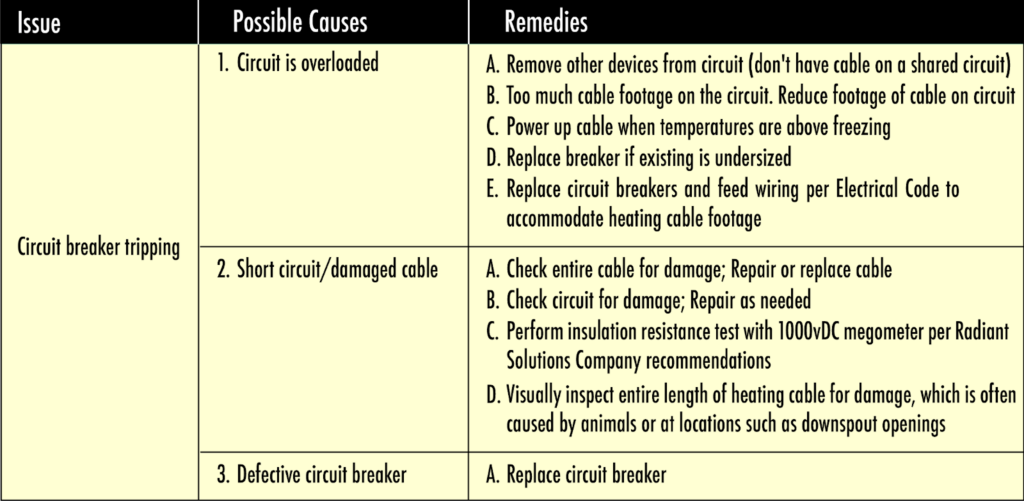
If the circuit breaker keeps tripping whenever you use the heat tape, there are three common causes to investigate:
Overloaded Circuit: Heat Tape can draw significant current, especially on cold startups. If you have too much heat cable on one circuit or other appliances on the same circuit, it may exceed the breaker’s capacity. An overloaded circuit will trip the breaker as soon as the cables draw power. The solution is to reduce the load: unplug/disconnect other devices or put some of the heat tape on a different dedicated circuit. We advise against running heat cable on a shared circuit with other devices. In practical terms, if you hear a buzz or hum and the breaker trips when the tape powers on, that’s a sign the circuit is at its limit and needs to be split or upgraded.
Damaged Cable Causing a Short: If the heat tape’s insulation is compromised (for example, from a sliced outer jacket), moisture can get in and create a short-circuit or ground fault. A shorted cable will immediately trip the breaker (or a GFCI) to protect the system. In this scenario, the tripping is actually a safety feature and it means the cable is likely damaged. You should inspect the full length of the cable for damage. A cut or crushed section, sometimes caused by a sharp edge/point or an animal, could be causing a direct short. If you find damage, contact us about what to do. We will ask some questions and give you guidance. If you have a pre-terminated cable, plug it in to a different outlet to see if that circuit trips. This process of elimination can help determine if the problem is related to the cable or the circuit.
Defective or Oversensitive Breaker: Sometimes the issue isn’t the cable at all but the breaker itself. A worn-out or faulty circuit breaker might trip even if the load is within limits. Heat tape systems often run for long durations, which can stress an old breaker over time. If you’ve ruled out overloads and cable damage, consider that the breaker may need replacement. Replacing the breaker (or having an electrician evaluate it) can resolve nuisance trips if the breaker was simply weak or overly sensitive. Always ensure the breaker amperage is appropriately sized for the total wattage of your heat tape runs as well.
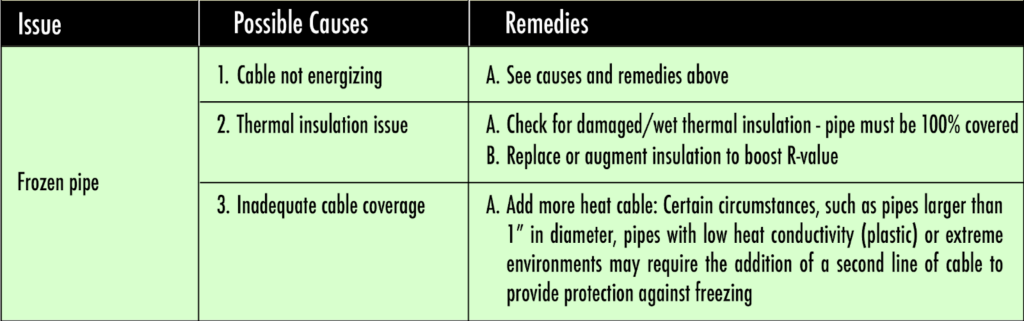
It’s frustrating to have a pipe freeze despite heat tape being in place. In our experience, this usually comes down to one (or more) of three issues:
No Power to the Cable: The heat tape might have lost power without you realizing. If the tape was unplugged or a breaker/GFCI tripped, the cable will not heat the pipe. This is the first thing to check. Make sure the system actually had power throughout the cold period. All heat tape, Pro and pipe freeze pro cables have LED indicator lights in the plugs. If those LEDs are not illuminated, that’s your first clue that you have a power issue.
Poor or Wet Insulation on the Pipe: Heat tape alone isn’t enough; the pipe also needs to be properly insulated on top of the cable. If your pipe’s thermal insulation was inadequate, missing in spots, or became wet, the heat retention drops dramatically. Use a minimum 1/2″ thickness standard pipe insulation because the heat tape needs that insulation to trap its warmth around the pipe.
Insufficient Cable Coverage or Output: In very cold climates or for large-diameter pipes, a single run of heat tape might not output enough heat to prevent freezing. Heat Tape PRO is self-regulating (about 6–10 watts per foot depending on conditions), but extreme environments can overwhelm a lone cable. For example, a 2-inch PVC water pipe in sub-zero temperatures may require more than one cable run. Plastic pipes, pipes over 1″ diameter, or pipes installed in extremely cold environments may need a second line of cable to provide adequate freeze protection.
Conditions such as outdoor temperatures and snow depth have a dramatic effect on how heat cable melt patterns appear. Lower temperatures (below 20ºF) will result in narrow pathways while warmer temperatures create wide pathways. Don’t be fooled. As long as there is even a small melted margin around the cable it will do its job, which is to allow water to drain. All of the below examples are functional heat cable systems. (Yes, even the cables that are buried in snow!)
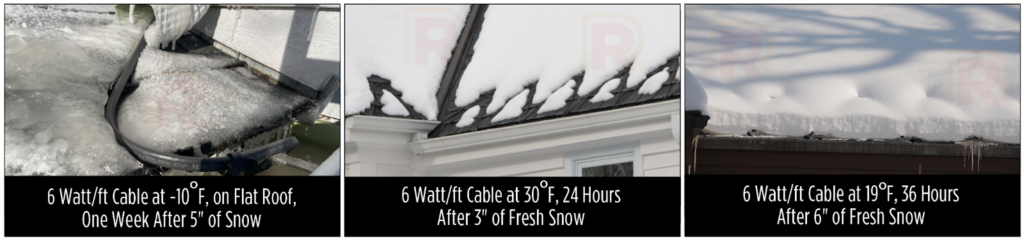
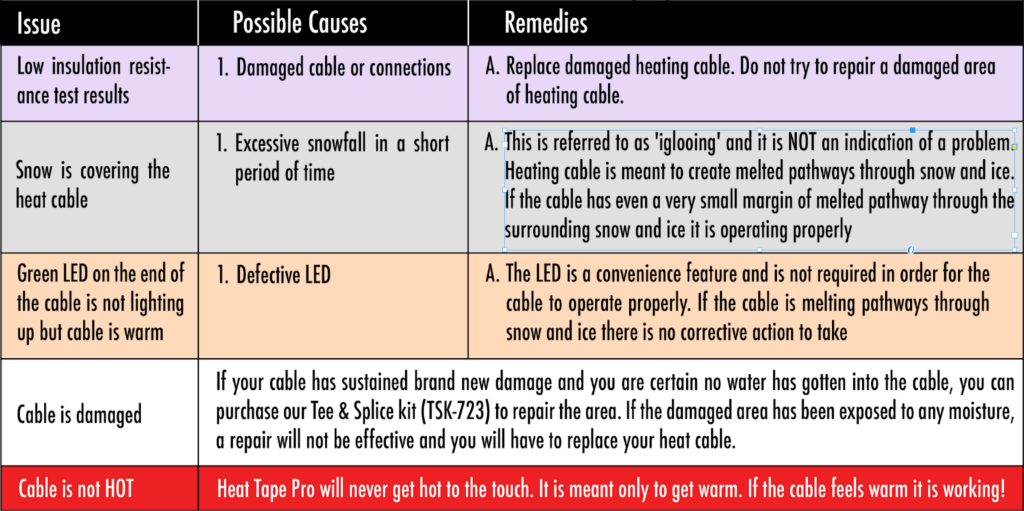
Yes, it’s completely normal to see snow covering an active heat cable on your roof. Sometimes a layer of snow on top of the cable forms a small insulated tunnel around it, sometimes called “iglooing.” This is not a sign of a problem. The purpose of Heat Tape PRO is not to melt large areas of snow on your roof but rather to melt channels or pathways through the snow and ice. As long as the cable has a small melted margin around it, the cable is working as intended.
Keep in mind that Heat Tape PRO only warms up to a modest temperature. It’s designed to get warm, not hot, typically maxing out under about 100°F (which is just slightly above body temperature). That gentle heat is sufficient to carve through ice and prevent ice dams, but it won’t instantly melt all the snow on contact. As long as you have those melted “tunnels” or edges where water can flow, your heat tape system is doing its job.
Heat Tape PRO is designed to get warm, not hot. Under normal operation, it will feel warm to the touch, never hot. This is one reason it’s safe to have contact with all varieties of roofing and building materials commonly found in residential and commercial construction.
At full output in very cold conditions, the surface temperature of the cable might be 40–50°F, but that’s about it. This gentle warmth is by design. It provides enough heat to prevent ice accumulation and freeze-ups without running up the temperature excessively (which would waste a lot of electricity). In fact, because it self-regulates, when the ambient temperature is close to freezing, it may only feel a little warm or even neutral to the touch. The key point: not feeling “hot” is normal. As long as you can detect some warmth (in freezing conditions) or see it melting ice, the heat tape is reaching the proper temperature.
Unlike constant wattage cable found in big-box stores, which can get dangerously hot and can’t be overlapped, Heat Tape PRO’s self-regulating technology adjusts heat output based on temperature. This means it only uses the energy needed and never gets hot enough to cause damage, even if the cable overlaps itself.
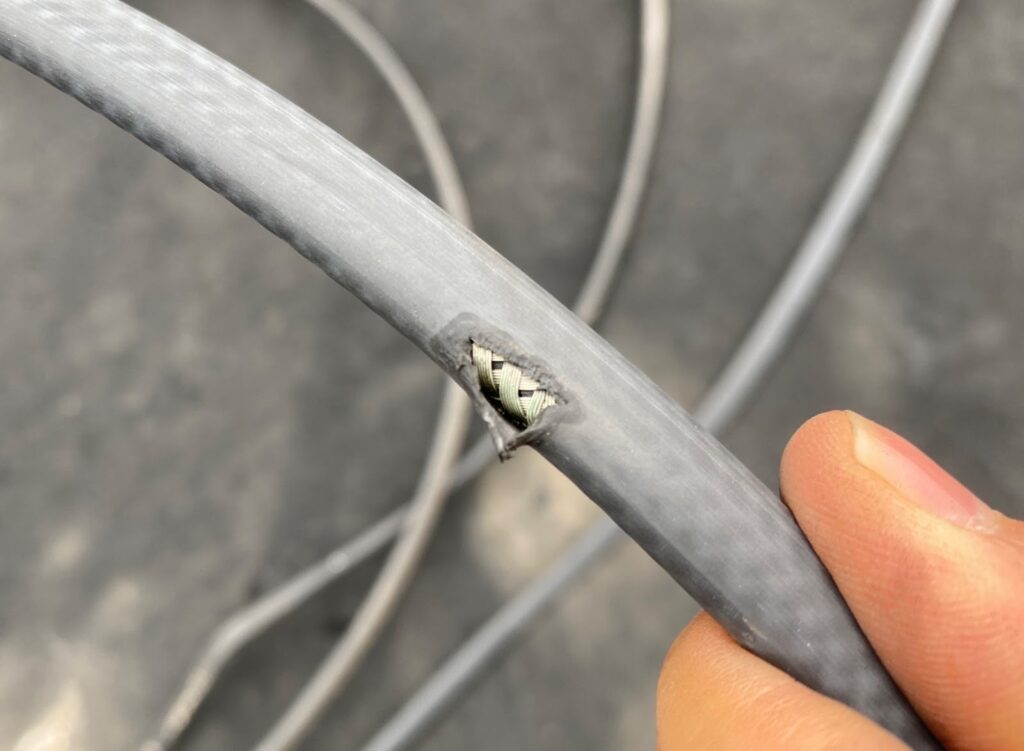
If you are dealing with constant wattage cable like the kind sold in big-box stores, repairs are not possible. Repairing a damaged self-regulating heat tape is possible in certain circumstances. If the damage is limited and water has never been allowed to leak into the area you can perform a repair using a splicing kit. Radiant Solutions offers a Tee & Splice Kit (TSK-723) that allows you to repair heat tape by cutting out the damaged segment and splicing the cable back together. This is typically used when someone accidentally cuts or drills through a cable during installation or shortly thereafter.
In terms of heat cable repairs, if the damaged area has been exposed to moisture all bets are off. Generally speaking, the more recent the damage, the more likely the repair will succeed. Once water works its way into the cable’s core, the self-regulating matrix and conductors can start to degrade. In that case, even a splice repair might not hold up (or could be unsafe).
There are several common hazards that can damage heat tape over time:
Rodents Chewing the Cable: By far one of the most frequent causes of damage is animals gnawing on the cable. Rodents (especially squirrels and mice) can bite through the outer cable jacket and even the inner conductors. While not a common issue we do hear about this a few times a year.
Accidental Damage During Maintenance: Some heat tape damage happens during roof or gutter maintenance. The cable can get pinched or cut by tools used in the process of re-roofing or other exterior work around the cable system. Always be mindful of where the heat cables are when doing any work on the roof. If hiring contractors (roofers, painters, etc.), remind them about the presence of heat tape so they don’t accidentally damage it during their work.
Downspout and Yard Equipment Damage: The ends of downspouts are a common area for heat tape damage. Cables often run through gutters and then exit at the bottom of downspouts where they can be hit or cut. Radiant Solutions sells a Cable Guard to shield the cable against damage from sharp edges, screw points, and other mechanical means. It’s cheap insurance to protect an expensive heat tape system.
The takeaway is simple. Heat cable systems tend to fail at transition points, and the bottom of the downspout is one of the most vulnerable. Protecting the cable where it exits the downspout and being mindful around it during yard work can significantly extend the life of the system.
While many Heat Tape PRO issues can be resolved with basic troubleshooting, some situations require professional assistance:
If you need help troubleshooting your Heat Tape PRO system or want to connect with a professional installer in your area, contact us at 952-444-2044. We’re here Monday through Friday, 8 AM to 5 PM Central Time, and we actually know this stuff.