
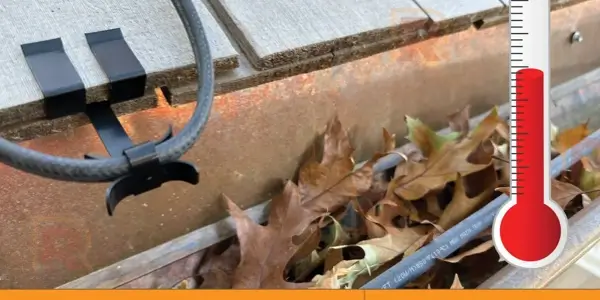

One of the most common questions we get asked is about how hot does heat cable get?. People are naturally concerned about whether heat cable is safe to be in contact with a wide variety of things including roofing material, plastics, dry leaves and more. Let’s explore temperature expectations for our 6/watt Heat Tape PRO self-regulating heat cable in different outdoor ambient conditions.
Self-regulating heat cable is designed to warm up but not become dangerously hot. In practice, the cable stays relatively low temperature, typically under 100°F (38°C) even at maximum output. This is only slightly above normal body temperature, meaning the cable usually feels lukewarm to the touch. A good rule of thumb is that it will generally not feel any warmer than your forehead in standard installation environments including roof and gutter de-icing and pipe freeze heat trace projects.
| Outdoor Temperature Range | Expected Cable Temperature | Cable Behavior |
| Freezing (-40°F to 32°F) | 40°F – 60°F | Maximum output to fight cold |
| Cold (32°F to 50°F) | 60°F – 90°F | High output, distinctly warm |
| Mild (50°F to 70°F) | 60°F – 100°F | Moderate output, mildly warm |
| Warm (70°F to 90°F) | 70°F – 110°F | Minimal output, barely warm |
Please note that these temperature ranges are estimates and can vary based on installation factors and specific conditions.
Self-regulating cable adjusts its heat output based on the surrounding temperature. As the ambient temperature decreases, the cable generates more heat. Likewise, as surrounding ambient temps increase self-regulating heat tape reduces heat output. This self-regulating feature helps prevent overheating and saves energy.
In extremely cold conditions (for example 0°F), the cable runs at its maximum output to fight the cold but will remain only moderately warm. As outdoor temperatures rise above freezing, the cable’s output starts to dial back. For instance, at 40°F, the same cable might output of 6W/ft compared to 8 W/ft at freezing.
Is Self-Regulating Heat Tape a Fire Risk?
No, self-regulating heat cable is not a fire hazard when properly installed. These cables are specifically engineered to be safe in contact with any common roof or pipe materials and to avoid overheating. Unlike some constant-output heat tapes that could get extremely hot, self-regulating cable only gets warm.
For those wondering what Heat Tape PRO self-regulating heat cable can “touch” without risk of fire, the answer is essentially ANYTHING. Any common roofing material, any common pipe material. Any plastic, metal or wood. You could wrap Heat Tape PRO with paper and bury it in a pile of dry leaves and it will not cause a fire because our cable is designed to get warm, not hot.
Self-regulating heat cable automatically calls for more energy when ambient outdoor temperatures are lower and conversely, less energy when outdoor temperatures are higher. This adaptive behavior translates to significant energy savings compared to older constant-wattage heat tapes that use full power all the time, even if the weather is mild.
It’s important to note a common misconception: self-regulating heat cable does NOT turn itself completely off and on. Self-regulating heat cable will always draw power when plugged in. While it draws far less power when it’s warmer outside and more when it’s cooler, it never fully deactivates 100% on its own, it simply reduces its output to a very low level.
Because of this, the addition of a thermostatic controller can reduce overall energy costs over time. Many people install heat cable in combination with a thermostat (or a simple plug-in temperature controller) that actually cuts power to the cable when the outside temperature is above a certain threshold (for example, above 37°F). The thermostat serves as an on-off switch based on ambient conditions, so that the cable is truly off and drawing no power in warm weather, then automatically comes on when temperatures drop near freezing. Our ThermaCord is our most popular thermostatic controller.
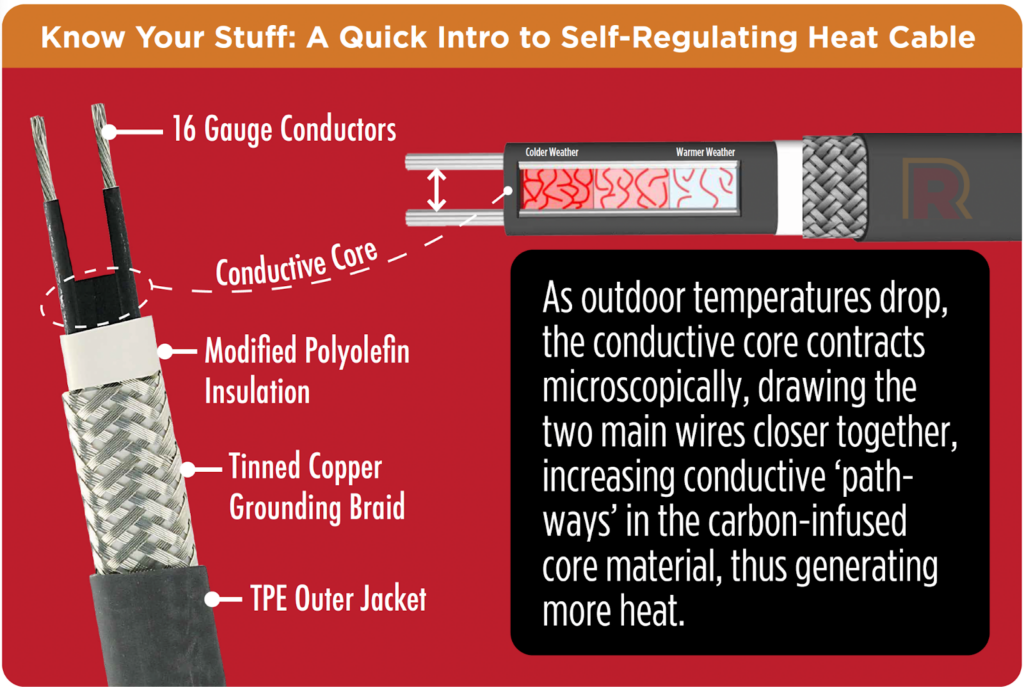
A self-regulating heat cable consists of several layers. At the center are two parallel 16 Gauge Conductors. These are surrounded by a Conductive Core. An inner jacket of Modified Polyolefin encases the core. This is covered by a Tinned Copper Grounding Braid, and the entire assembly is protected by a TPE Outer Jacket.
As outdoor temperatures drop, the conductive core contracts microscopically, drawing the two main wires closer together, creating more electrical “pathways” in the carbon-infused core material, thus generating more heat. When temperatures rise, the core material expands, increasing resistance and reducing current flow. This technology allows the cable to automatically modulate its heat level in response to the environment, so it runs hotter in cold weather and cooler in warm weather.
Self-regulating heat cables adjust their heat output based on the ambient temperature around them. The term “self-regulating” means the cable automatically adjusts its power output in response to the temperature of its surroundings. In cold conditions, the cable’s internal core becomes more conductive, drawing more electricity and producing more heat. In warmer conditions, the core’s resistance rises, reducing the current flow.
In effect, the cable gives you more heat when you need it and less when you don’t, without any manual intervention. This means you’re not wasting electricity overheating a pipe or roof that isn’t in danger of freezing. In practical terms, a self-regulating cable may consume far less power on average over the season than an equivalent constant heat tape, because during all those hours when it’s not frigid, the self-regulating cable is drawing only a trickle of power.
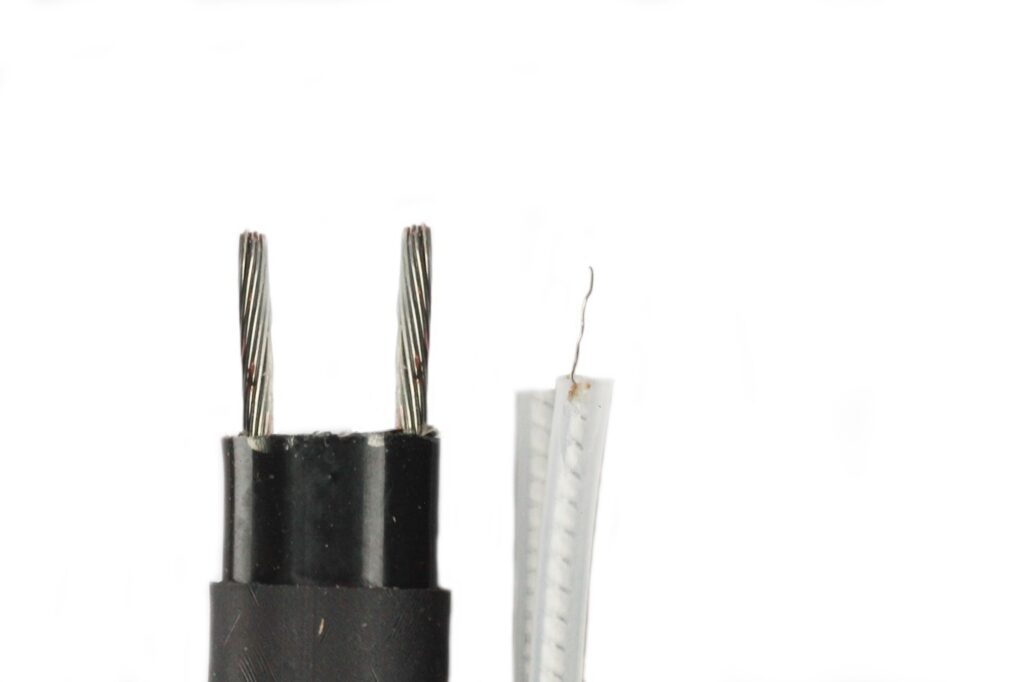
Self-regulating and constant wattage heating cables differ significantly in how they operate and how efficient they are. Understanding these differences helps explain why self-regulating technology represents a superior solution for most applications.
Self-Regulating Heat Cable contains a special conductive core that automatically adjusts its resistance with temperature. A self-regulating cable can sense local conditions along its length and vary its heat: if one section is cold (say exposed to freezing air), that segment of cable will draw more power and heat up, while an adjacent section that’s warmer will draw less power. They never overheat to dangerous levels. Self-regulating cables can be used on virtually any material (metal, plastic, wood, rubber roofs, etc.) without risk. They have a long lifespan (often around 10 years or more) and are generally considered a premium, reliable solution for freeze protection and ice dam prevention.
Constant Wattage Heat Cable outputs the same fixed amount of heat along their entire length, as long as they are powered on. There is no self-adjustment – whenever you plug it in, it will draw its full rated wattage per foot continuously, regardless of the ambient conditions. As one expert notes, constant-wattage cable “does not automatically adjust… It is hot, hot, hot, 100% of the time when plugged in.” This all-the-time full power makes constant wattage cables less efficient – they often consume much more electricity than necessary during milder weather.
Because constant-wattage cables don’t self-limit their temperature, they can get excessively hot if misused. You typically cannot overlap or bunch up a constant watt cable – if the cable crosses over itself, that concentrated heat can cause the insulation to degrade or even start a fire. Many constant wattage kits also restrict what surfaces they can be used on. They tend to have shorter warranties (1-3 years) and lifespans.
In summary: A self-regulating heat cable automatically varies its heat output with the temperature (saving energy and preventing overheating), while a constant wattage cable outputs full power at all times when on (simpler but far less efficient). Self-regulating cables are considered more advanced – they are energy-saving, safer to use, and more versatile.Need help determining how much heat cable you need? Use our Heat Cable Calculator to calculate the size of heat tape you should get based on your specific situation.