
Ice dams cause damage by trapping water on the roof and forcing it into places it was never meant to go. That water works its way under shingles, through nail holes, into soffits and wall cavities, leading to stained ceilings, rotted wood, mold growth, and costly interior repairs.
When ice dams form on a roof, average homeowners have very few safe options to deal with the issue. The problem feels urgent because water damage may already be happening, but most removal methods people reach for make things worse. Chopping at ice with hammers, axes, or ice picks almost always damages the roof.
Valleys are especially vulnerable. A single hard strike can puncture or deform valley metal, creating leaks that may not show up until the next heavy rain.
There is also a serious safety issue. Ice covered roofs are slippery and unpredictable. Adding sharp tools increases the risk of injury or falls. In many cases, the damage caused during removal ends up costing more than the ice dam itself. Once an ice dam has formed, mechanical removal is rarely the answer and often creates bigger problems than it solves.

It is almost always less expensive to prevent ice dams than to remove them or repair the damage they cause. Once an ice dam has formed, removal becomes labor intensive, time sensitive and expensive. Safe removal requires specialized equipment and trained crews and even then it only addresses the ice that exists at that moment.
Without prevention in place, the problem often comes right back. Ice dams are driven by weather patterns, not bad luck. If conditions repeat, the ice dam will reform in the same location again and again throughout the winter. That means multiple service calls, repeated disruption, and mounting costs.
Leading ice dam removal experts, including The Ice Dam Company, report returning to the same homes as many as four times in a single season to remove ice dams from the exact same areas. Each visit costs money, and none of them reduce the likelihood of the next ice dam forming.

Prevention changes that equation. Whether through architectural improvements, targeted heat cable, or a combination of approaches, prevention breaks the cycle. Instead of paying repeatedly to react to ice dams after they cause stress or damage, you invest once to reduce or eliminate the problem before water has a chance to get inside.
Ice dams are not caused by snow alone. They form when snow and temperature line up in just the wrong way. You need snow on the roof and you need uneven roof temperatures. When portions of the roof warm above freezing, snow begins to melt. That meltwater then flows downhill until it reaches a colder section of roof near the eaves, where it refreezes.
There is a very specific temperature range where this process accelerates. The most common ice dam conditions occur when nighttime lows hover around fifteen degrees and daytime highs climb into the mid twenties. At those temperatures, enough heat escapes from the home to warm the upper roof surface, but the eaves remain cold because they extend beyond the heated structure of the house.
As this cycle repeats, meltwater refreezes over and over in the same location. The ice builds upward and outward, eventually forming a dam that blocks drainage. Once that dam is in place, water has nowhere to go except sideways and backward under the roofing system.
This is why ice dams tend to form in the same spots year after year. They are not random events. They are the predictable result of roof geometry, heat loss, and weather patterns lining up in an unfortunate but very repeatable way.
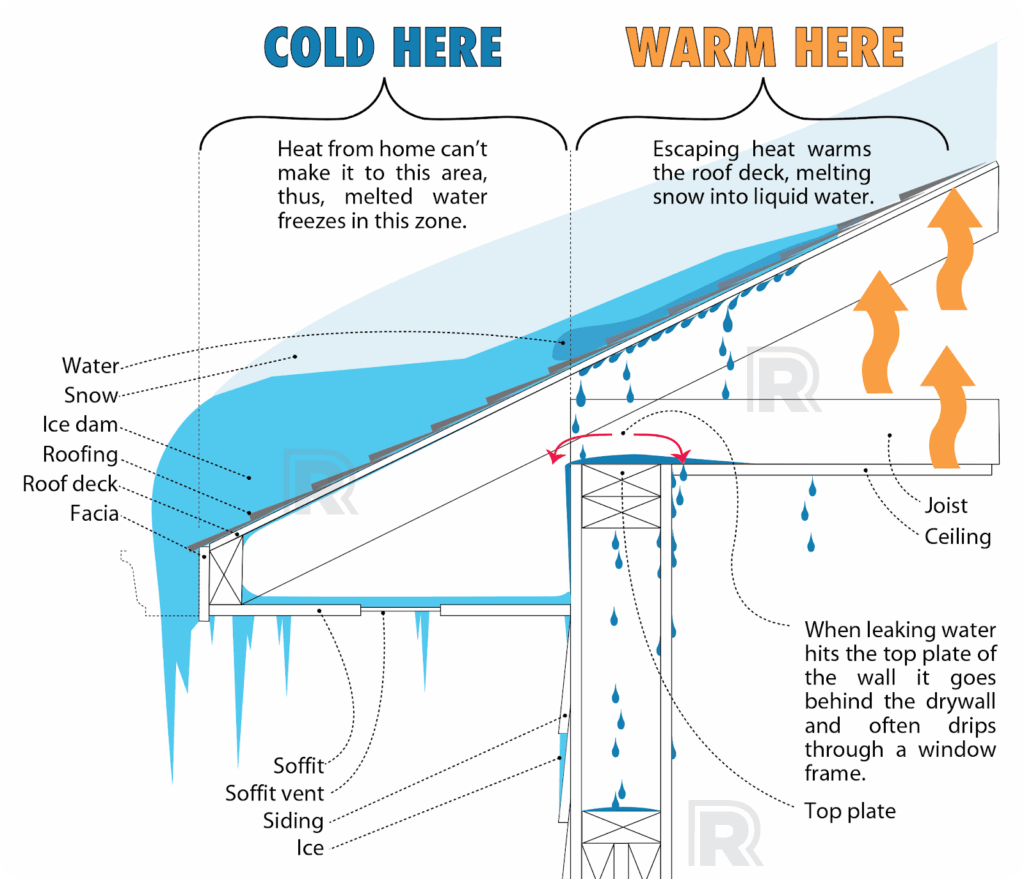
Illustration courtesy of Kuhl’s Contracting Inc.
Just because you have icicles hanging off the edge of your roof or gutters doesn’t mean that you necessarily have ice dams. It’s true that large icicles are often associated with ice dams, but it’s also true that ice dams can occur without visible icicles. Outside of leaks in winter, there are six classic warning signs to watch for:
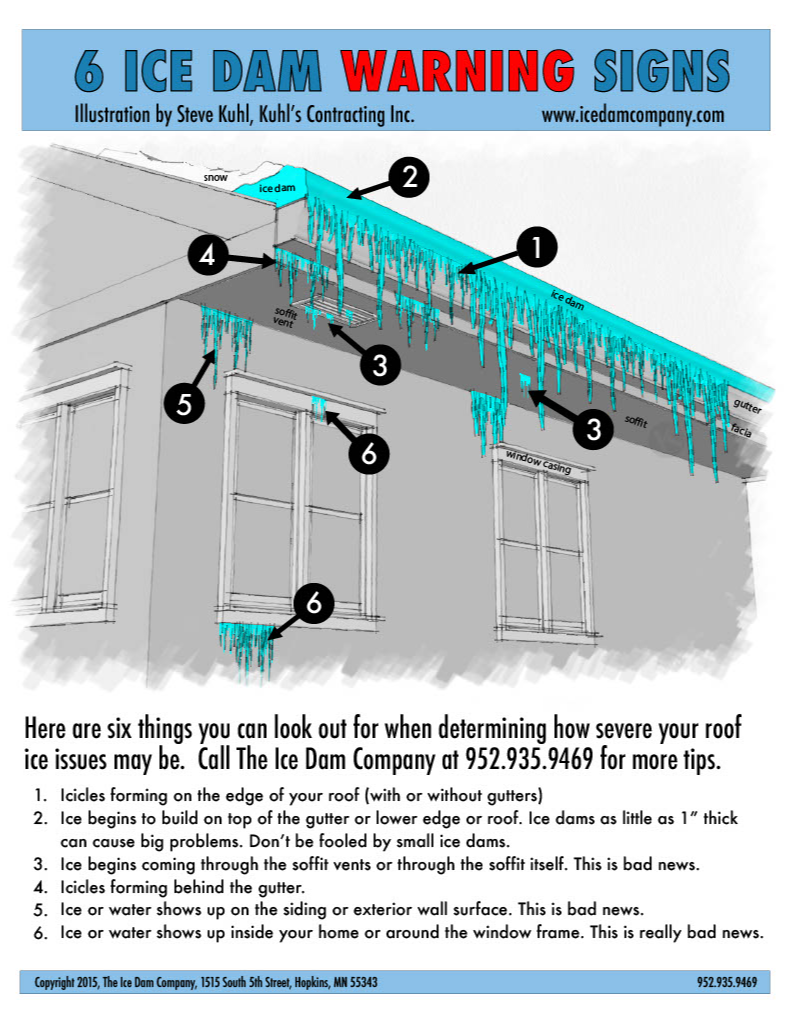
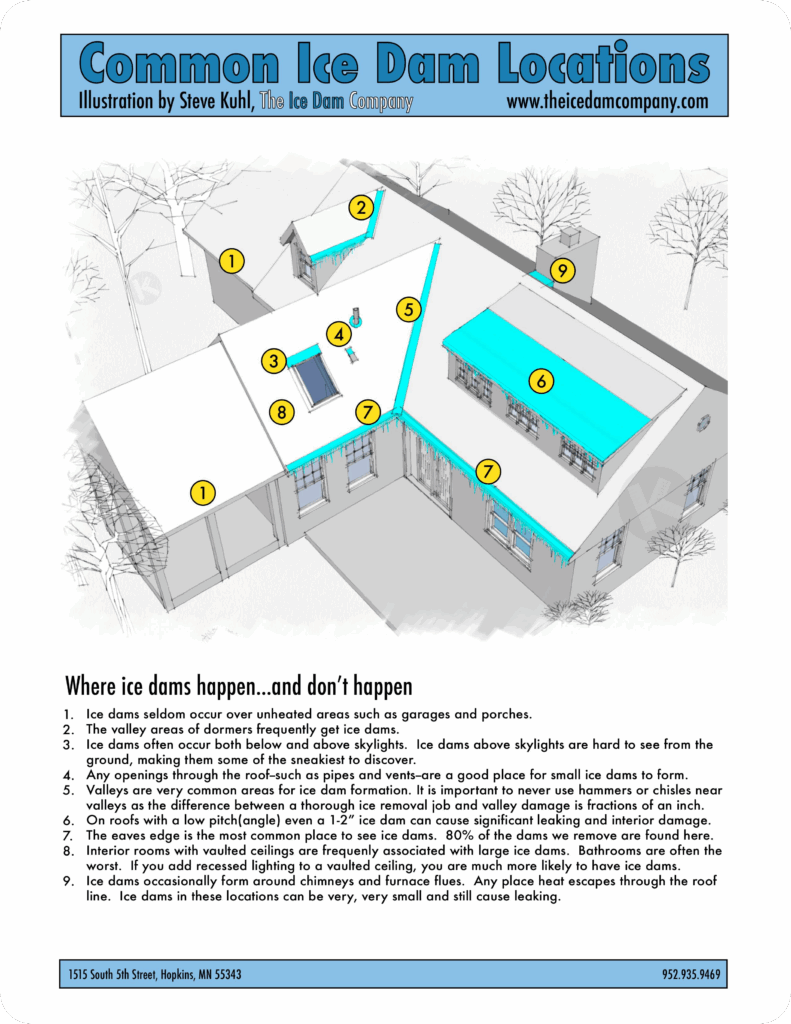
Ice dams most commonly form along the eaves, which is the lower edge of the roof directly above exterior walls. This is where warm roof surfaces transition to cold overhangs, creating the perfect refreezing zone. In fact, roughly eighty percent of the ice dams we see occur right at the eaves. That is why this area gets most of the attention and why it is the first place prevention strategies are usually focused.
That said, ice dams are not limited to eaves alone. Dormer valleys are frequent trouble spots because they concentrate snow, channel meltwater and often sit above interior spaces with complex framing and insulation gaps. Valleys in general are high risk areas. They collect large volumes of water and even small amounts of ice in a valley can force water sideways and under roofing materials. This is also why valleys are so easily damaged during improper ice removal.
Skylights are another sneaky location. Ice dams often form both below and above skylights. Dams above skylights are especially difficult to see from the ground, which means leaks may already be happening before anyone realizes there is a problem. Any opening through the roof surface, including plumbing vents and exhaust pipes, can also create small but damaging ice dams. Even minor heat loss at these penetrations can be enough to start the freeze thaw cycle.
Low slope roof sections deserve special mention. On roofs with minimal pitch, even one or two inches of ice can cause significant leaking because water does not drain quickly. Ice dams also frequently show up near vaulted ceilings, particularly in bathrooms. Recessed lighting in vaulted ceilings is a common contributor, as it allows warm air to leak directly into the roof assembly.
Chimneys and furnace flues are another overlooked area. Any place where heat escapes through the roofline can create a localized ice dam. These dams are often very small but still capable of causing leaks. On the flip side, ice dams rarely occur over unheated areas such as garages or porches, which helps confirm that heat loss, not gutters or snow alone, is the real driver.
Understanding these common locations makes ice dams far more predictable and prevention far more effective. Instead of guessing, you can focus on the areas where ice dams actually form and design solutions that address the real problem, not just the visible ice.
The only proven, safe method for removing ice dams is with high temperature steam. Steam melts ice without mechanical force, which means it does not cut, bruise, or puncture roofing materials. When done correctly, steam removal eliminates the ice while leaving shingles, flashing, and valley metal intact.
Unfortunately, not all ice dam removal methods advertised as steam actually are. Many contractors claim to use steam when they are really using high temperature pressure washers. This matters because pressure washers rely on force, not heat. Even when using lower pressure settings, high temperature pressure washers can damage roofing materials.
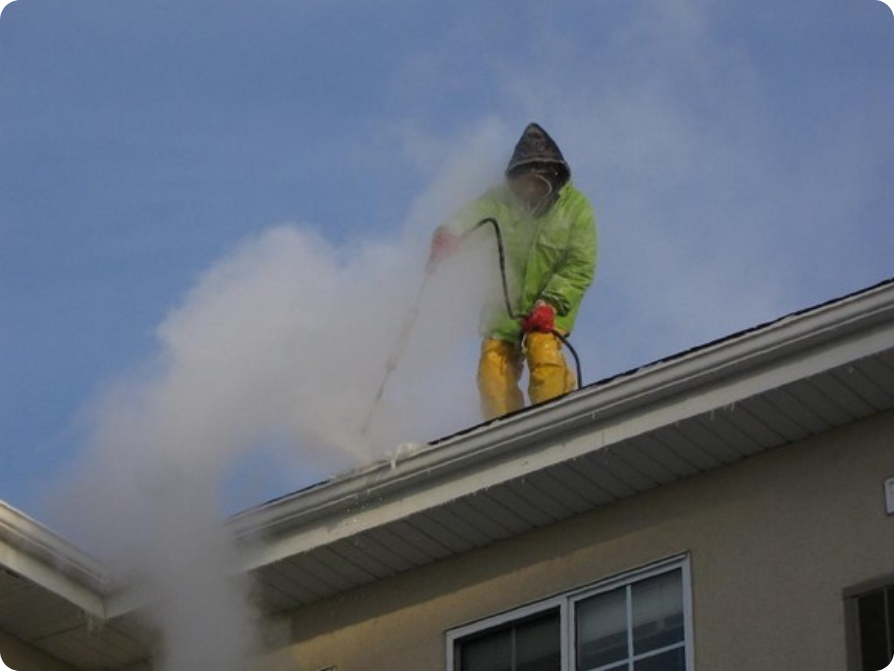
The easiest way to tell the difference is the wand. True steamers operate with an open wand. There is no trigger and the flow never stops. The machine generates constant high temperature vapor that melts ice on contact. Pressure washers always have a trigger. If the operator is squeezing a handle to start and stop the flow, it is not steam.
Using the wrong equipment can cause more damage than the ice dam itself. Steam works because it removes ice gently and predictably. Anything that relies on pressure introduces risk, even if the water is warm. When it comes to ice dam removal, steam is not just the best option. It is the only one that consistently removes ice without damaging the roof.
How can you avoid being scammed by unethical ice dam removal companies? Simple. If they’re claiming to use steamers, let them know that you’re going to test the temperature of the steam coming out of their machine. A $10 meat thermometer will do the trick. High temperature pressure washers will produce something approaching steam for one or two minutes but then the temperature quickly drops off down to around 150°F. If you don’t see at least 225°F, you’re not dealing with a steamer, you’re dealing with a high temperature pressure washer. Bad news.
Speaking of ethics, even with the use of a true steamer it’s possible to get ripped off during the course of having your ice dams removed. When you’re paying $400-$800 per hour for this work, every minute counts. A common tactic used by unscrupulous ice dam removal contractors is one of the oldest scams around: Milking the clock. The easiest way to do this with a steamer is to simply melt all of the ice off of the roof. On the surface that doesn’t sound unethical, does it? The fact is, upstanding ice dam removal contractors only need to melt about 15% of the ice to get the job done. Most of the ice is removed by gravity. Here’s how.
The most efficient and ethical way to remove ice dams without roof damage is by cutting channels through the ice dam with a steamer every 16″ or so, then undercutting the ice between those slots with steam. After the undercut is performed, the block of ice will slump down onto the roof where it can be picked up and thrown off with ease. This process creates manageable sections that can be safely removed without harming the roof. Unethical contractors, in contrast, attempt to melt every cubic inch, which dramatically increasing time and cost. Our research indicates that most experienced ice removal contractors can remove 10 to 15 feet of ice dam along an eave per hour.
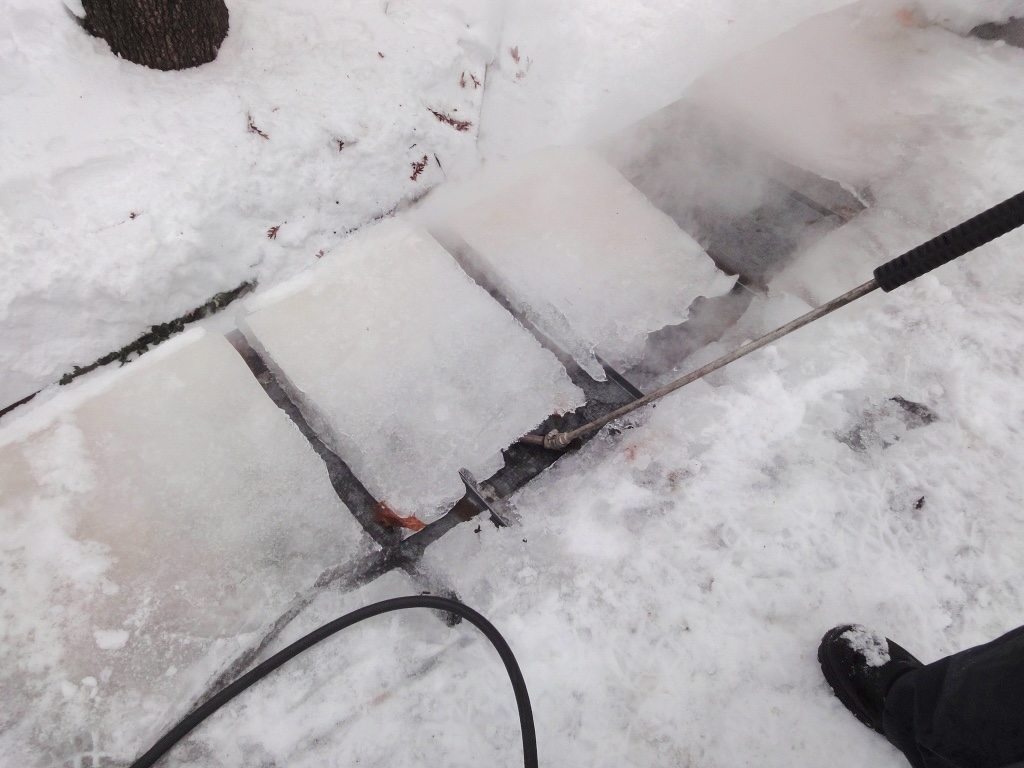
Professional ice dam removal is expensive due to the specialized equipment and expertise required. Steamers cost $5,000 or more, and most contractors charge between $400–$800 per hour for a one- or two-person crew. Total project time varies based on the roof height, ice thickness, and outside temperature.
If water is already entering your home through the ceiling, punch a small hole where the water is collecting and place a bucket below it. This relieves pressure, preventing water from spreading across ceilings or seeping into light fixtures. A small repair later is far easier than replacing larger areas of damaged drywall.
Special thanks to the experts at The Ice Dam Company for providing information and graphics for this section of our website.
The Ice Dam Company, founded in Minneapolis in 2003, was the first large-scale ice dam removal and prevention company in the United States. Their expertise inspired modern techniques for ice dam management and prevention, including innovations in heat cable design. Their sister company, Kuhl’s Contracting, remains a leading resource for ice dam prevention education.
