

Ice dams form when portions of a snow-covered roof warm up enough to melt snow, resulting in meltwater that runs down the roof to a colder edge where it refreezes. This creates a ridge of ice that traps water behind it, forcing moisture under your shingles and into your home.

The Skinny: Warm air escapes the heated interior, warms the roof deck, melting snow above which sends meltwater down the roof to the unheated eave, where it refreezes to form an ice dam. An ice dam forms due to a temperature difference between the main part of a roof and its edge. For an ice dam to develop, the upper sections of the roof must be above freezing (warmed to >32°F) while the lower edge stays below 32°F.
The section of the roof directly above the heated interior of the home is a warm zone. Here, heat from the interior escapes and warms the underside of the roof deck, which in turn melts the snow on top of it. As discussed in Case Study #128, the origin zone of ice dams on eaves is typically directly above the top of the exterior wall.
This meltwater flows down the roof until it reaches the eave or overhang, which is a cold zone. Heat from the home’s interior cannot reach this area, so the roof surface is cold. As the meltwater from above flows onto this cold section, it refreezes, forming a ridge of ice known as an ice dam.
The process follows four distinct steps:
According to the University of Minnesota Extension, this cycle continues each day as more snowmelt feeds the growing ice dam at the edge.
As the ice dam grows, it creates a pool of water behind it on the roof. This standing water can seep underneath the roofing shingles and through the roof deck, leading to leaks inside the home.
When the leaking water reaches the building’s exterior wall it hits the top plate and goes behind the drywall or plaster and drips down through the interior of the wall cavity. This can cause damage to structural components and interior finishes, including the studs, ceiling, drywall/plaster, window trim, window frames and sashes.
Backed-up water works its way beneath shingles and through nail holes in the ice and water membrane and through the seams of the roof deck. This moisture path affects multiple building components:
| Building Component | Type of Damage |
| Roof deck & rafters | Warping |
| Attic insulation | Saturation, loss of R-value |
| Ceiling materials | Staining, sagging, collapse |
| Interior walls | Moisture intrusion, mold growth |
| Window frames | Warping, staining |
| Gutters | Loosening, tearing off |
| Fascia & soffit | Water damage, warping |
| Exterior siding | Paint damage, deterioration |
The most visible sign of an ice dam is the ice dam itself often seen as a ridge of ice along the eaves with long icicles draping down from the gutters or roof edge. There are six warning signs to watch for:
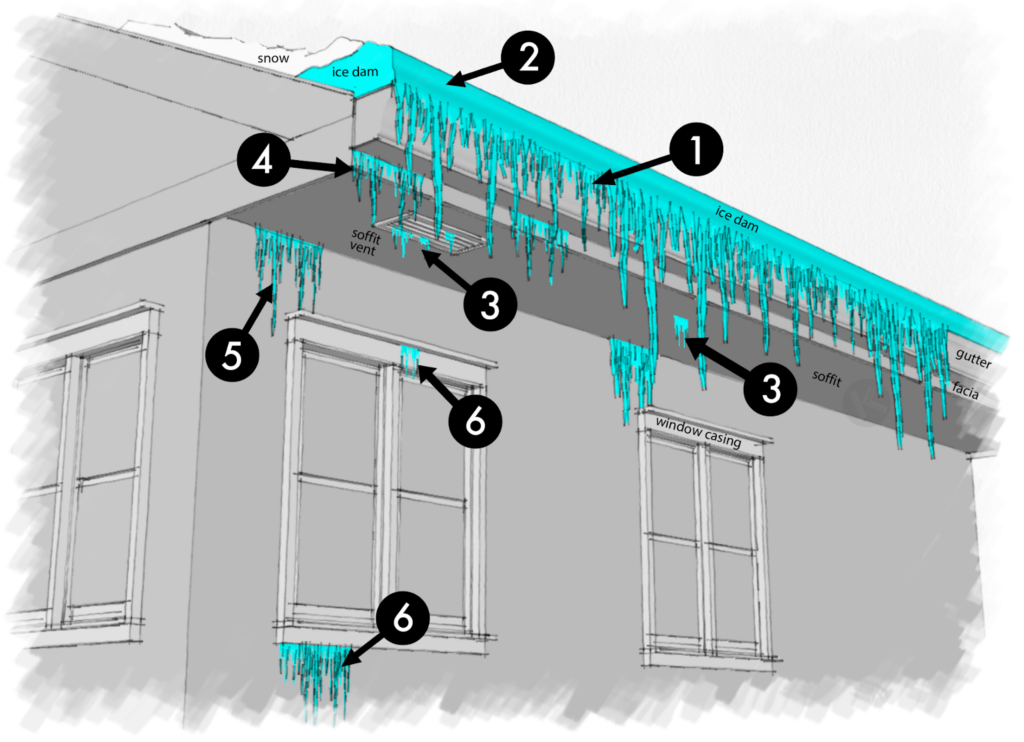
According to The Ice Dam Company in Minneapolis, Minnesota, even a relatively thin ice accumulation (an inch or two) at the roof edge can be enough to cause problems. An ice dam is sometimes not obvious, especially in valleys or along higher roof sections.
When it comes to determining if you should be worried about the ice dam on your home, here’s the most important takeaway: Any ice seen between the fascia (or back side of gutter) and the exterior wall means water is likely inside your wall cavity and this ice dam is causing damage.
How Much Cable Do You Need? Click here to use our Heat Cable Calculator
Need help with installation? Find a Heat Tape PRO installer in your area or call us at 1-877-387-4218. Our team has been solving ice dam problems for over 35 years. We’re here to help.
Radiant Solutions Company
1515 5th St S Suite K, Hopkins, MN 55343
Phone: 1-877-387-4218
www.radiantsolutionscompany.com